Section 103 BNS: Punishment for Murder vs IPC 302 – The Complete 2026 Legal Guide
The transition from the colonial-era Indian Penal Code (IPC) to the Bharatiya Nyaya Sanhita (BNS) 2023 has brought about the most significant shift in Indian criminal jurisprudence in over 160 years. At the heart of this transition is Section 103 of the BNS, which now governs the punishment for murder—a role previously held by the iconic Section 302 of the IPC.
For legal practitioners, law students, and the general public, understanding Section 103 is not just about memorizing a new number. It is about understanding the procedural upgrades under the BNSS (Bharatiya Nagarik Suraksha Sanhita) and the introduction of specific clauses targeting organized group violence.
What is Section 103 of BNS 2023?
Section 103 of the Bharatiya Nyaya Sanhita defines the punishment for the offence of murder (which itself is defined under Section 101 BNS). While the core definition of murder remains largely consistent with the old Section 300 of the IPC, Section 103 is split into two distinct parts that carry heavy legal implications.
Section 103(1): Individual Liability
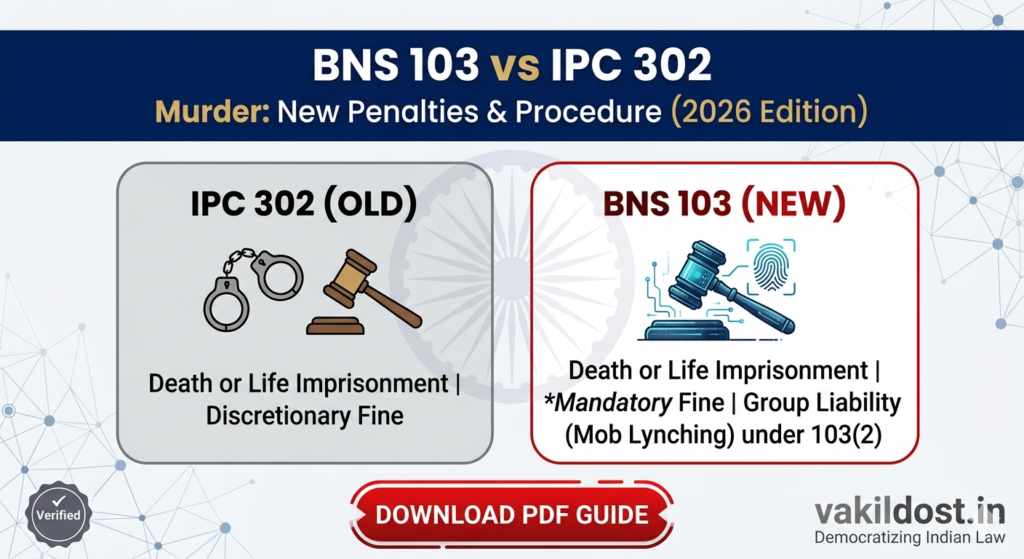
This clause is the direct successor to Section 302 IPC. It states that whoever commits murder shall be punished with death or imprisonment for life, and shall also be liable to a fine. The “Rarest of Rare” doctrine established in Bachan Singh v. State of Punjab continues to apply here, ensuring that the death penalty is reserved for the most heinous crimes.
Section 103(2): The “Mob Lynching” Clause
This is the most transformative addition to India’s murder laws. For the first time, the statute explicitly addresses murder committed by a group of five or more persons acting in concert. If a murder is committed based on discriminatory grounds such as Race, Caste, Community, Sex, or Language, each member faces death or life imprisonment. This specifically targets identity-based hate crimes—a gap previously filled by complex interpretations of Section 34 or 149 of the IPC.
Comparative Analysis: Section 103 BNS vs. Section 302 IPC
| Feature | Section 302 IPC (Old) | Section 103 BNS (New) |
|---|---|---|
| Core Punishment | Death or Life Imprisonment | Death or Life Imprisonment |
| Fine | Discretionary / Usually added | Mandatory Fine added to jail term |
| Group Liability | Relied on Section 34/149 IPC | Specifically defined in 103(2) |
| Classification | Cognizable & Non-Bailable | Cognizable & Non-Bailable |
| Triable By | Court of Session | Court of Session |
Procedural Mandates under BNSS 2023
Under the new Bharatiya Nagarik Suraksha Sanhita (BNSS), the investigation of a Section 103 case is far more technical than before:
- Mandatory Forensic Examination: For any offence punishable by 7 years or more, forensic investigation is now mandatory. Evidence collection must be videographed on an electronic device to prevent tampering.
- Strict Timelines: The Sessions Court must frame charges within 60 days of the first hearing, and judgments must be delivered within 30 days of concluding arguments.
- Victim Updates: The Investigating Officer (IO) must inform the victim of the progress within 90 days.
How to Draft a Complaint under Section 103 BNS
Key elements to include in your legal draft:
- Reference the definition: Always cite Section 101 BNS (Definition) alongside Section 103 (Punishment).
- Identify the Clause: For group crimes, explicitly invoke Section 103(2).
- Digital Evidence Reference: Cite the electronic recording mandates of the Bharatiya Sakshya Adhiniyam (BSA).
Why This Matters for Residents of Noida and Delhi/NCR
With the Surajpur District Court and the Delhi High Court adopting “Digital-First” procedures, staying updated is crucial. Whether you are an advocate practicing in Gautam Buddha Nagar or a citizen seeking justice, the shift to BNS 103 represents a more transparent, forensic-heavy justice system.
📥 BNS, BNSS & BSA Master Guide 2026 | New Laws Mapper
Explore a free online overview and the IPC-to-BNS reference table. Verify the relevant provisions against current official statutes.
Open Free Online ReferenceDisclaimer: This article is for informational purposes only and does not constitute legal advice. For specific legal issues, consult with Advocate Rajat Kaushik or a registered legal professional at vakildost.in.