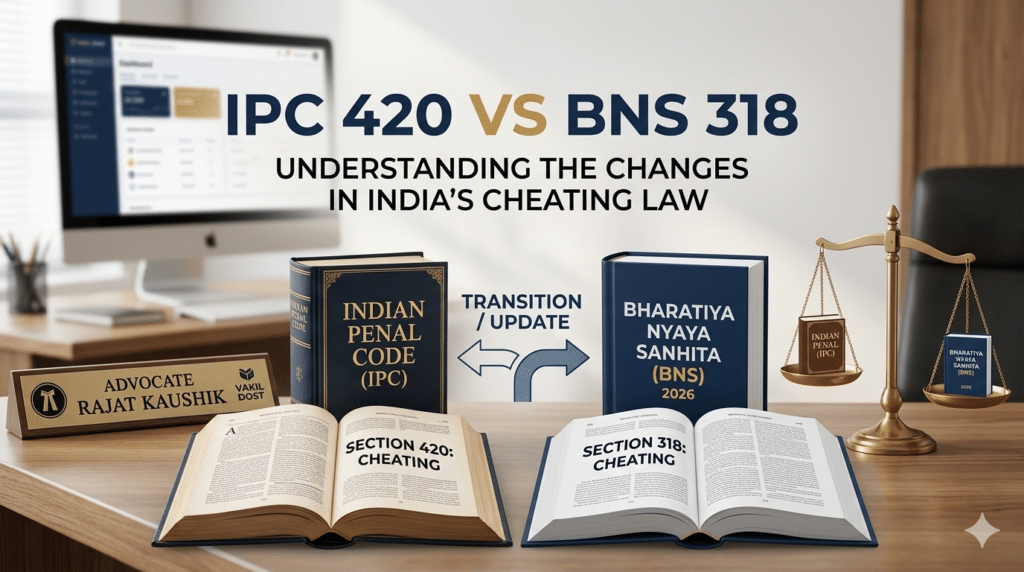
IPC Section 420 vs BNS Section 318: What Changes for Your Cheating Case?
For decades, the term “420” (Chaar-Sau-Bees) has been synonymous with cheating in the Indian vocabulary. However, as of the 2024 legal transition, the Indian Penal Code (IPC) has been replaced by the Bharatiya Nyaya Sanhita (BNS). If you are a common citizen, a student, or someone currently involved in a legal matter, you must understand that IPC Section 420 vs BNS Section 318 is the most critical shift you need to know.
In this guide, we break down exactly what has changed, what remains the same, and how this affects a cheating case in India today.
🔍 Looking for a different Section?
Use our Master BNS vs IPC Mapper to find any old IPC section’s new BNS equivalent in seconds.
Open Master Mapper →1. The Shift: From IPC Section 420 to BNS Section 318
Under the old regime, Section 420 of the IPC dealt with “Cheating and dishonestly inducing delivery of property.” In the new legal framework of 2026, this entire concept has been reorganized. When comparing IPC Section 420 vs BNS Section 318, the first thing to notice is that the definition of “Cheating” is now found in Section 318 of the BNS.
The goal of this change was to modernize the language and streamline the judicial process, making it easier for the “common man” to navigate.
2. Defining Cheating under BNS 318
The core definition remains similar, but the structure is tighter. According to Section 318, a person is said to “cheat” if they:
- Deceive any person.
- Fraudulently or dishonestly induce that person to deliver any property.
- Intentionally induce a person to do or omit to do anything they would not otherwise do.
While analyzing IPC Section 420 vs BNS Section 318, it is clear that the “intent” of the law has been preserved, but the section numbers used in FIRs and court summons have changed. If an incident happens today, it will be registered under BNS 318, not IPC 420.
3. Punishment: Is it Tougher under BNS 318?
One of the hottest questions for any cheating case in India is the duration of imprisonment. Under the old IPC 420, the punishment was up to 7 years plus a fine.
Under the BNS Section 318, the punishment is categorized:
4. What Happens to Old IPC 420 Cases?
If you have an ongoing case that was filed before the new laws came into effect, don’t panic. Under the principles of Indian law, your case will continue to be tried under the old IPC Section 420. The new BNS Section 318 applies only to offenses committed after the implementation date. This is a crucial distinction that Advocate Rajat Kaushik emphasizes for all common users of VakilDost.in.
5. Why the Change Matters for the Common Citizen
The transition from IPC Section 420 vs BNS Section 318 is part of a larger mission to decolonize Indian law. For a “Dost” (friend) of the court, this means: