
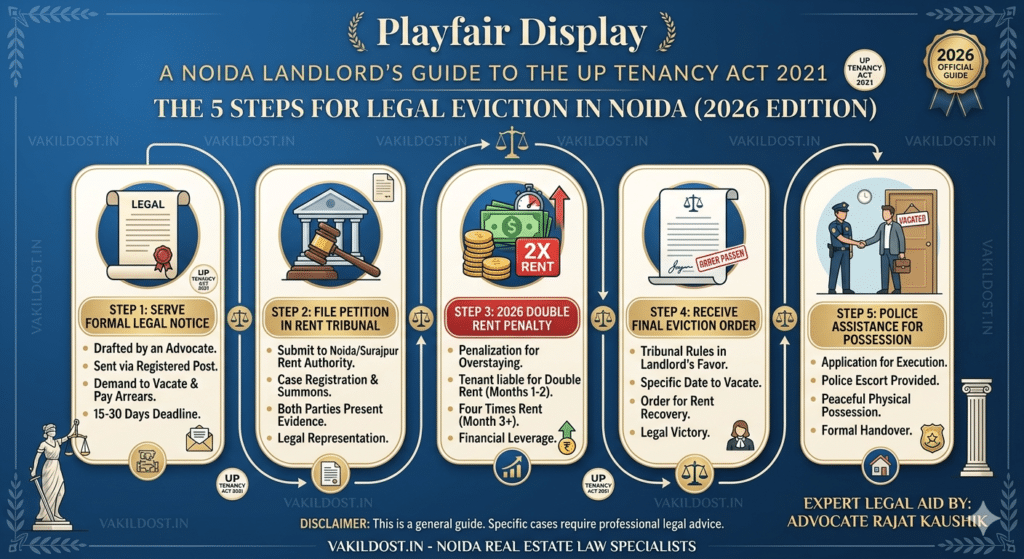
In the high-demand rental markets of Noida and Greater Noida, a “holdover tenant” can become a landlord’s worst nightmare. However, the UP Tenancy Act 2021 (official text) has shifted the power dynamic back to property owners who follow the law.
If your tenant is refusing to vacate despite the lease expiry or non-payment of rent, 2026 laws provide a fast-track resolution. Here is how to reclaim your property without getting entangled in criminal counter-suits.
The “Notice to Quit” Strategy
Never start with an argument; start with a Formal Legal Notice. In Noida, a WhatsApp message is not sufficient proof for the Rent Tribunal. You must serve a notice via Registered Post giving the tenant 15–30 days to vacate. This document is the foundation of your eviction case.
Grounds for Eviction in 2026
Under Section 21 of the UP Tenancy Act, you can seek immediate eviction if:
- Rent Arrears: Non-payment for 2 consecutive months.
- Agreement Expiry: Tenant stays after the lease ends.
- Misuse: Residential flat used as an office or “PG”.
- Damage: Tenant causes structural harm to the property.
The Rent Authority Petition
If the tenant ignores the notice, we file a petition before the Rent Authority in Surajpur/Noida. Unlike traditional civil courts, Rent Tribunals are mandated to resolve disputes quickly. Most “Professional Tenants” vacate the moment they receive a summons from the Authority.
💰 The “Double Rent” Penalty
The 2026 legal framework is financially brutal for stubborn tenants. If the Tribunal finds the tenant is overstaying, they must pay Double the Monthly Rent for the first two months, and Four Times the Rent thereafter. This financial pressure is your biggest leverage.
Execution of Eviction Order
Once the Rent Tribunal passes the order, the tenant is given a final window to move. If they still refuse, the Authority provides Police Assistance to physically restore possession to the landlord. You do not have to confront the tenant yourself.
With the right legal support, landlords can navigate through the complexities of a tenant not vacating flat Noida 2026 efficiently.
To summarize, a tenant not vacating flat Noida 2026 poses a unique challenge that requires patience, strategy, and legal knowledge. Following the proper steps can lead to a successful resolution.
Ultimately, the goal is to resolve the issue without further escalation. A tenant not vacating flat Noida 2026 can cause stress for landlords, but with the right approach, it is manageable.
Dealing effectively with a tenant not vacating flat Noida 2026 involves understanding your legal options. Knowing the various grounds for eviction under the UP Tenancy Act can empower landlords facing this challenge.
Landlords must remain vigilant when a tenant not vacating flat Noida 2026 refuses to leave. The legal repercussions can be severe if the process is not followed properly.
Legal Rights Against a Tenant Not Vacating Flat Noida 2026
The eviction process begins with a clear communication strategy, especially when a tenant not vacating flat Noida 2026 is involved. Providing a formal notice can sometimes encourage voluntary compliance from the tenant.
When dealing with a tenant not vacating flat Noida 2026, it’s crucial to follow the legal framework to avoid complications. The UP Tenancy Act 2021 provides a structured approach for landlords facing such issues. A tenant not vacating flat Noida 2026 can lead to significant financial losses, making it imperative to act promptly and legally.
The situation becomes critical when a tenant not vacating flat Noida 2026 prolongs their stay beyond the lease term. Understanding your rights as a landlord is essential. If you find yourself in this predicament, knowing the legal steps can help expedite the eviction process. Many landlords face challenges when a tenant not vacating flat Noida 2026 continues to occupy the property without justification.